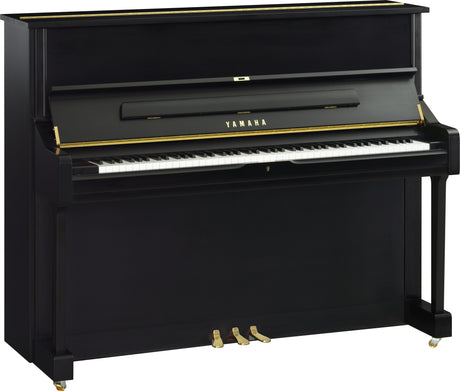
When a child starts piano lessons, the question of the right instrument comes up early. A piano for kids should convey the real technique used in lessons from day one and grow with the child for years.
The decisive point is the key action. An acoustic piano has a true hammer action: each key moves a hammer against the string through a lever. It is exactly this playing feel, with weight and touch dynamics, that forms the foundation a child is meant to learn in lessons.
01Why an acoustic piano is ideal for learning
Piano lessons build on the hammer action from the very first session. Touch, finger strength and the fine grading from soft to loud only develop when the keys have real weight and respond precisely to every stroke.
An acoustic piano delivers this playing feel directly and without compromise. The child practises at home on the same mechanical principle used in lessons and transfers what was learned without readjustment. Added to this is the unamplified, physical sound in the room, which trains the ear for tone colour and dynamics.
02Which beginner pianos prove reliable
For starting out, solidly built pianos with a mature action are the right choice. They play reliably, hold their tuning and accompany a child throughout the whole learning period.
A classic for the start is the Yamaha B10 Klavier schwarz poliert, the most compact model of Yamaha's b series with a precise action and balanced tone. The Yamaha B20 Klavier schwarz poliert offers a little more tonal volume and cabinet height. To aim slightly higher from the outset, the Kawai K-200 Klavier schwarz poliert from Kawai's proven K series is an instrument that also carries advanced students for many years. A wider choice of beginner and step-up models is available in the Klaviere - Neu category.


03New or used for the first piano
Both paths can make sense for a child's piano. A new piano offers a full life cycle, a predictable action and a fresh instrument that stays reliable throughout the learning years. A well-kept used piano can open up a high-quality model at a lower entry price.
With used instruments the checked condition is key: action, tuning stability and string condition decide its suitability for practice. The article “Buying a piano: new or used?” covers the comparison of both paths in detail.
| Aspect | New piano | Used piano |
|---|---|---|
| Action | brand new, full life cycle | depends on checked condition |
| Entry price | predictable by model | often lower per quality tier |
| Suitability for practice | consistently high | high when condition is checked |
04Setting a realistic budget
A new beginner piano with a real hammer action starts with the compact b series models and rises with cabinet height, brand and features. More important than the lowest price is a mature action, since it decides whether practising stays enjoyable over the years.
To spread the budget at first, a piano can also be financed or acquired through hire purchase, distributing the cost across the learning period. We deliberately avoid exact prices here, as models and terms change; the current prices are shown directly on the product pages.
05Digital piano as a bridge and the step up later
If space, volume or budget speak against an acoustic piano at the start, a digital piano with a fully weighted hammer action can be a sensible bridge. It offers a piano-like feel and allows practising with headphones. The fundamental trade-off is covered in the article “Digital piano or acoustic piano?”.
Many families plan the path in stages from the outset: first a solid beginner instrument, later the step up to a larger piano once the child has progressed. A proven step-up target is the Yamaha U1 Q Klavier, which carries well beyond the school years. At Musik Ebert, trading in the first instrument when upgrading is possible, so the value already invested is preserved.

An acoustic piano with a real hammer action gives a child the best foundation for piano lessons. A solid beginner model lasts for years, and the path can be planned in stages from the very start.
Frequently asked questions
From what age does a piano for kids make sense?
Is a digital piano enough to learn the piano?
New or used for the first piano?
What does a good beginner piano cost?
Find the right beginner piano
Discover new beginner pianos from Yamaha and Kawai for a strong start in piano lessons.
View new pianosView the Yamaha B10Passende Produkte