

Buying a hybrid piano and knowing what to look for becomes a real question once you want the feel of a true piano but cannot tune or house an acoustic instrument. Stringless hybrid pianos fill exactly that gap: they use a genuine upright or grand piano action with wooden hammers, yet generate the sound digitally.
A key distinction: this guide covers stringless hybrids such as the Yamaha AvantGrand, the Kawai Novus and the Casio Celviano Grand Hybrid. They deliberately have no strings and no soundboard. That sets them apart from Silent and TransAcoustic pianos, which are full acoustic pianos with strings that simply add a digital function. How that technology works is covered in our article on Silent and TransAcoustic pianos; this guide stays with the stringless hybrids.
01The action: a true upright or grand feel
The most important buying criterion is the action, because it defines a hybrid piano. Unlike an ordinary digital piano with a weighted keyboard, a hybrid uses a real piano action with wooden hammers, the same build found in acoustic instruments. Instead of striking a string, the hammer movement is read by non-contact sensors and translated into the digital sound.
What matters is whether the instrument has an upright action (vertical, as in an upright piano) or a grand action (horizontal, as in a grand piano). A grand action with its repetition function allows fast note repeats and a lighter, more direct release, making it the choice for demanding players. The Yamaha NU1XA AvantGrand Hybrid Piano – inkl. Lieferung & Aufbau uses a genuine upright action, while the Kawai Novus NV12 Hybrid Piano schwarz poliert – inkl. Lieferung & Aufbau uses a grand action in a console format. When buying a hybrid piano, weigh this against your own playing needs.


02Sound generation: sampling or modeling
The second major difference lies in how the sound is created. Two approaches have become established. With sampling, real concert grands are recorded in detail and played back as you perform; Yamaha draws on the CFX and the Bösendorfer Imperial, Kawai on its concert grands. With modeling, the sound is instead calculated in real time from an acoustic model; in the Celviano Grand Hybrid, Casio uses the AiR Grand sound source, whose Berlin Grand was developed together with C. Bechstein.
In practice, both approaches deliver a very lively sound at this level. Sampling often feels especially authentic against the original recording, while modeling responds sensitively to playing nuances and dynamics. Listening matters more than spec sheets here, and both routes lead to a convincing result.
03Speakers, headphones and volume
Because a hybrid piano generates the sound digitally, the volume is fully adjustable, a key advantage over an acoustic instrument. You can practise during the day through the built-in speakers and in the evening through headphones, without disturbing neighbours or family.
The speaker system is worth a closer look: high-quality hybrids use multiple ways and upward and downward firing drivers to create a spatial sound that surrounds the player. The Casio Casio Digitalpiano / Hybrid Piano GP-310 Celviano - schwarz matt, for example, uses a multi-element speaker system built into the console body. Also check for two headphone outputs for playing together and for a headphone sound optimisation that preserves the spatial impression when playing with headphones.
04Connectivity, app and integration
Anyone buying a hybrid piano usually makes use of its digital features too. Check for USB-to-Host to connect a computer or tablet, MIDI to drive software and, where available, Bluetooth for audio and MIDI. Many models include a manufacturer app that brings sound selection, recording and accompaniment functions to the tablet.
For teaching, an Aux input to play along with backing tracks and a recording function are valuable. This connectivity is not a side note: it determines how well the instrument fits into a daily routine of practice, online lessons and the occasional recording.
05Format, space and maintenance
Stringless hybrids come in an upright console format and, more rarely, in a grand shape. The console format is space-saving and fits almost any room, while the grand shape needs more floor space but offers the look and action feel of a small grand. Compare weight and depth with the intended location before buying.
An often underestimated advantage concerns maintenance: a hybrid piano never needs tuning and stays stable, because no strings are under tension. It is also unaffected by changes in temperature and humidity. Running costs are therefore much lower than for an acoustic piano. Our Digitalpianos category gives an overview of the current models.
| Model | Action | Sound generation | Format |
|---|---|---|---|
| Casio GP-310 Celviano | Grand Hammer Action, wooden keys | Modeling (AiR Grand) | Console |
| Yamaha NU1XA AvantGrand | genuine upright action | Sampling (CFX, Bösendorfer) | Console |
| Kawai Novus NV6 | genuine upright action | Sampling (Kawai concert grands) | Console |
| Kawai Novus NV12 | genuine grand action | Sampling (Kawai concert grands) | Console (grand action) |
When buying a hybrid piano, the action that defines the feel and the sound generation that suits your taste matter most. Connectivity, format and the absence of tuning round out the decision. If you are torn between models, start from your requirements for the action.
Frequently asked questions
What is the difference between a hybrid piano and a Silent piano
Does a hybrid piano need tuning
Sampling or modeling, which is better
Is a hybrid piano suitable for advanced players
Find the right hybrid piano
From a genuine piano action to a grand feel in console format, an overview of the stringless hybrids.
Browse all digital pianosDiscover the Kawai Novus NV6Passende Produkte
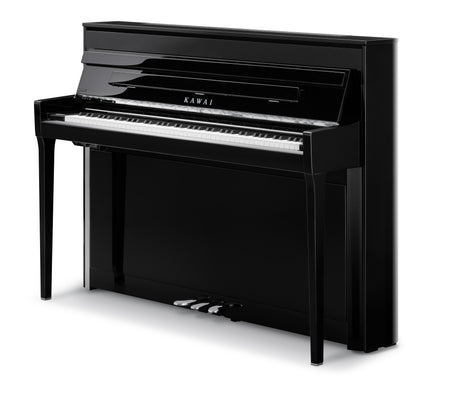
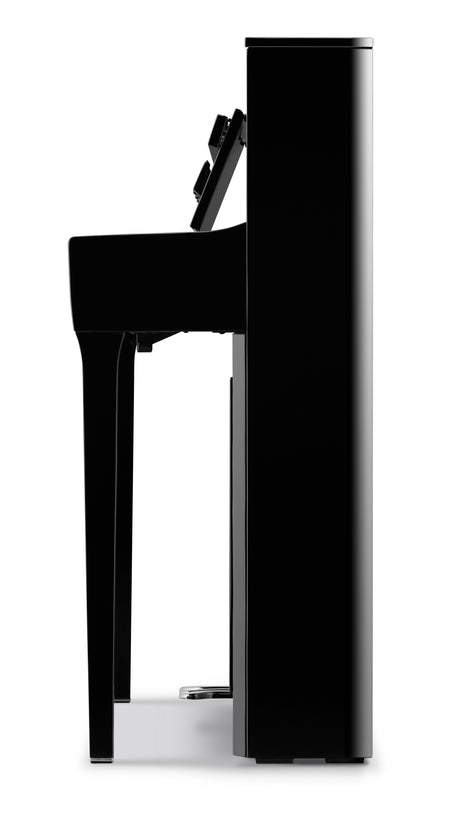
Kawai Novus NV6 Hybrid Piano Polished Ebony – Incl. Delivery & Assembly