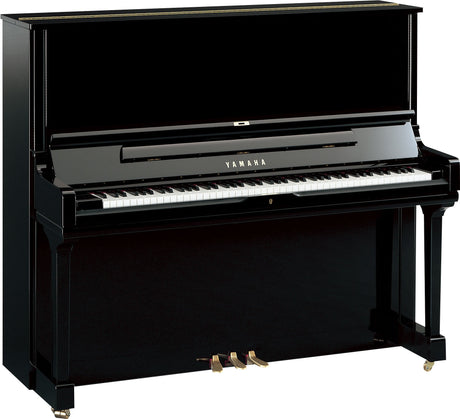
A Yamaha Silent Piano solves an old problem: playing a real piano at home without disturbing the neighbours or the sleeping children. It is not a digital piano and not a compromise, but a full acoustic piano with strings and hammer action that turns into a headphone instrument at the press of a pedal.
This guide explains what happens inside the piano when you switch over, how the two Yamaha systems SH3 and SC3 differ, which models carry them and who the technology really pays off for.
01What happens inside the piano when you switch over
In normal use, a silent piano is an entirely ordinary acoustic piano: the keys move the hammer action, the hammers strike the strings and the soundboard carries the tone into the room. The silent technology changes nothing about this as long as it is switched off.
When you engage silent mode, usually via the middle pedal or a small lever, a stop rail moves in front of the strings. It catches the hammers just before they reach the string. The result: the action runs exactly as always, but the strings are no longer struck. No acoustic tone is produced. The key point is that the piano stays fully playable, so the strings and soundboard remain in place and unchanged. Nothing is removed, silent mode is simply a layer you switch on.
02How the sound still reaches your headphones
If the strings stay silent, where does the sound in the headphones come from? This is where the sensors come in. Optical sensors read, without any contact, how fast and how deep each key and, on the higher-end system, each hammer moves. Contact-free means nothing rubs mechanically against the keys or hammers, so the touch stays unchanged.
This movement data is sent to a digital tone generator inside the piano. For every keystroke it plays back the matching recorded sound of a concert grand, finely graded by how hard you play. You hear this sound through the connected headphones. So you play on a real piano action with genuine key weight while hearing a high-quality digital grand-piano sound, with nothing audible in the room.
03SH3 or SC3: the difference between the two systems
Yamaha currently fits two silent systems. SC3 is the entry-level system and sits mainly on the more affordable models such as the B series. It captures your playing through precise key sensors and delivers a very good digital sound over headphones.
SH3 is the higher-end system on mid-range and upper-range pianos. It adds optical hammer sensors to the key sensors, reading playing behaviour even more accurately, including very slow keystrokes or fast trills. For the sound, SH3 relies on binaural sampling of the Yamaha CFX concert grand: over headphones this creates a spatial, natural impression, as if you were sitting at the grand piano itself. Anyone who practises often and demandingly in silent mode will clearly benefit from the SH3 system.
| Feature | SC3 | SH3 |
|---|---|---|
| Positioning | Entry-level system | Higher-end system |
| Typical models | B series | U, SE, SU, YUS series, grand pianos |
| Sensors | Key sensors | Key plus optical hammer sensors |
| Sound basis | Digital piano sound | Binaural CFX concert-grand sampling |
04Which Yamaha pianos carry the system
The neat thing about the silent concept is that it is not a separate instrument but a feature of well-known pianos. If you want an affordable entry-level piano with silent mode, you will find it with SC3 in the Yamaha B30 Klavier schwarz poliert mit SC3 Silent System, for example. One step up, with the SH3 system, are pianos such as the Yamaha SE-122 Klavier schwarz poliert mit SH3 Silent System or the larger Yamaha SU-7 Klavier - schwarz poliert mit SH3 Silent System.
In the upper segment, the YUS pianos carry the SH3 system, such as the Yamaha YUS-3 Klavier schwarz poliert mit SH3 Silent System and the larger Yamaha YUS-5 Klavier schwarz poliert mit SH3 Silent System. You will find an overview of all available models in our Klaviere - Neu category.


05Who a silent piano pays off for
The technology suits anyone who wants a real piano but cannot play loudly at all times. In a rented flat with thin walls, in a family with young children or for anyone who wants to practise late in the evening and at night, silent mode is the decisive advantage. During the day you play the piano fully acoustically, in the evening you switch to headphones.
If, on the other hand, you want to play almost exclusively through headphones and can do without the acoustic sound, a pure digital or hybrid piano is also worth considering. We explain the difference between silent, TransAcoustic and true hybrid pianos without strings in our further guides.
A Yamaha Silent Piano is not half a piano but a full acoustic instrument with a second, quiet layer. A real piano by day, a headphone instrument by night. Which model suits you depends mainly on how often and how demandingly you play in silent mode and how much acoustic sound you want.
Frequently asked questions
Does a Yamaha Silent Piano really sound like a real piano?
Is silent mode really inaudible?
What is the difference between SH3 and SC3?
Can I also play a silent piano fully acoustically?
Do I need special headphones?
Find the right silent piano
From the entry-level SC3 to the upper-range YUS piano with SH3: browse our current Yamaha pianos with a silent system.
See all pianosYamaha YUS-3 with SH3Passende Produkte


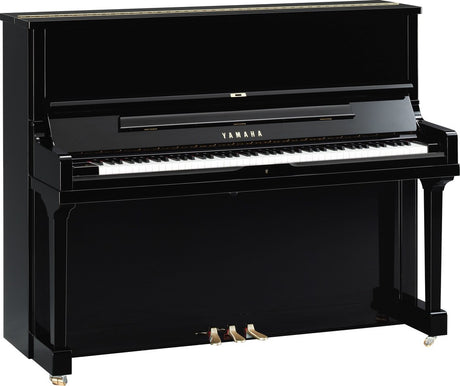
Yamaha SE-122 Upright Piano Polished Ebony with SH3 Silent System