

Anyone looking to buy a mandolin quickly faces three questions: how many strings the instrument has, how it is tuned, and what sets the teardrop-shaped A-Style apart from the scrolled F-Style. This guide answers them in order, so you end up knowing which body shape suits your music and your budget.
The mandolin is a double-course plucked instrument from the lute family. Its bright, sparkling tone carries folk, bluegrass and classical mandolin repertoire alike. Before buying, it pays to understand the basics, because string count, tuning and body shape are closely linked.
01Eight strings in four double courses
A mandolin usually has eight strings, arranged in four pairs. This paired layout is called double-course: two strings sit side by side and are fretted and struck together. Both strings of a pair sound the same note, tuned in unison. The purpose is to reinforce the sound. The floating, slightly choral mandolin tone comes precisely from this double stringing.
For the player this means: you fret four notes but hear eight strings. The lower two courses are wound strings, the upper ones plain steel. When restringing, you therefore buy a complete set of eight strings designed exactly for this layout.
02GDAE tuning: just like a violin
Mandolins are tuned in fifths, low to high G, D, A, E. That is exactly the tuning of a violin. So anyone who plays or once played violin finds their way around the fingerboard immediately, because the finger patterns are identical. Newcomers also benefit from the large body of sheet music that is interchangeable between the two instruments.
Each course is tuned to the same note. A tuner is a real help here, because eight strings need to be brought precisely onto four notes. A freshly strung mandolin needs a few days for the strings to settle and hold their pitch. During this break-in period you retune more often, which is completely normal.
03A-Style or F-Style: the body decides
The two most common body shapes go back to Orville Gibson around 1898. The A-Style has a plain, teardrop-shaped body with no ornamentation. It is usually more affordable, lighter and an ideal entry into folk and classical playing. The F-Style is recognised by its characteristic scroll at the upper body and its curved sound holes. It is more elaborately built, visually striking and the very image of the bluegrass mandolin.
Tonally the two are closer than their looks suggest. More important than A or F is the top: a solid spruce top vibrates more freely and develops more tone over the years than a laminated top. For beginners a well-built A-Style with good workmanship is often the more sensible choice; the F-Style is worth it when bluegrass is the goal or the striking look matters. Alongside these two arched-top shapes there is the flat-backed, Portuguese-influenced build, which sits more in traditional and folk music.


| Feature | A-Style | F-Style |
|---|---|---|
| Body shape | plain, teardrop | scroll on top, curved |
| Typical genre | folk, classical | bluegrass, folk |
| Price range | affordable entry | higher, more elaborate |
| Ideal for | beginners and classical | bluegrass and looks |
04Solid top or laminate
The most important tonal criterion when buying a mandolin is the top. A solid wood top, usually spruce, is made of continuous solid wood and vibrates freely. It sounds more open and dynamic and matures over the years. A laminated top, made of several glued layers, is more robust and cheaper, but sounds a little more restrained.
For a first step, a well-built laminated or part-solid mandolin is perfectly adequate and attractively priced. Anyone planning to stay with it long term, or who already plays an instrument, is better served by a solid top. In any case: clean workmanship, a straight fingerboard and a comfortable action matter more than any single spec detail.
05Strings, care and the first set
Mandolin strings wear faster than on many other instruments, because eight steel strings are tightly tensioned in a small space. A fresh set instantly brings back a tired tone. When restocking, look for a complete set of eight strings in the right gauge, for example with ball-end fastening for easy fitting.
Wiping the strings briefly after playing noticeably extends their life. When restringing, replace pair by pair so the bridge keeps its position. Spare strings and a tuner belong in your kit from the start, so the instrument is always ready to play.

Choosing the right mandolin follows a simple logic: eight strings in four double courses, GDAE tuning like a violin, then the choice between the plain A-Style and the striking F-Style. For folk and starting out the A-Style is often the calmer choice; for bluegrass and looks the F-Style. A solid top and clean workmanship count for more than any single detail.
Frequently asked questions
How many strings does a mandolin have?
How is a mandolin tuned?
What is the difference between A-Style and F-Style?
Which mandolin suits a beginner?
How often should mandolin strings be changed?
Find the right mandolin
From the plain A-Style entry to the F-Style for bluegrass: browse our selection of mandolins and matching accessories.
See all mandolinsA-Style beginner mandolinPassende Produkte


Gewa A-1 Select Mandolin with Case
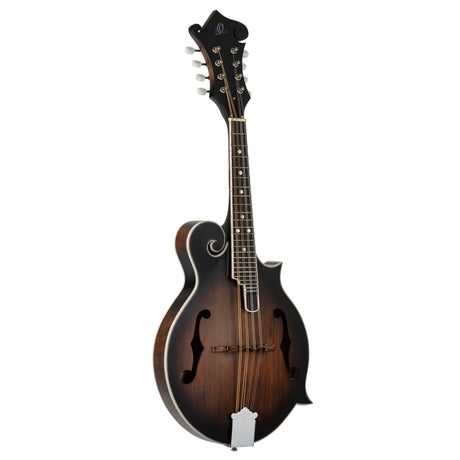
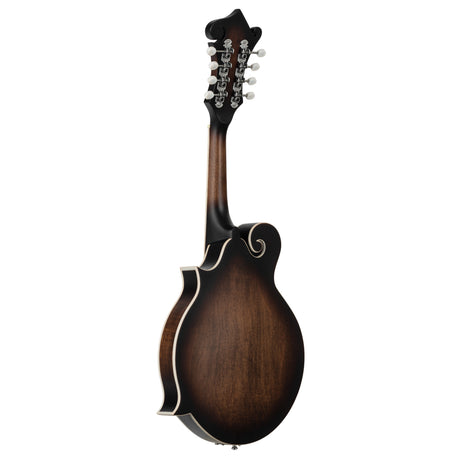
ORTEGA Americana Series F-Style Mandolin 8-String - Satin Whiskey Burst / Chrome Hardware