

Placing a piano decides more than just how the room looks. Location, room climate and the distance from heating and windows determine how well the instrument holds its tuning and how healthily the soundboard ages.
An acoustic piano is largely made of wood, and wood reacts to air humidity. This guide shows step by step what really matters for the location, from the wall question to the hygrometer.
01The right room: wall, outside wall and clearance
A piano sits most calmly against an inside wall of an evenly heated room. The old rule never to place an instrument on an outside wall barely applies to modern, well-insulated homes, because there are no longer sharp temperature swings at the wall. In an older building with a thin, cold outside wall, the inside wall remains the safe choice.
Leave a few centimetres between the back of the piano and the wall so air can circulate. Avoid direct sun through windows or skylights, and draughts near doors. A grand piano is ideally placed not directly under a window, but with the lid opening toward the room.
02Heating, windows and underfloor heating
The biggest strain on a piano is not high or low values in themselves, but rapid swings. A spot right next to or above a radiator dries the wood out badly in winter and should be avoided. The same goes for proximity to a fireplace or a ventilation outlet.
Underfloor heating is a special case: the rising, dry warmth reaches the lower part of the instrument and the soundboard especially directly. If the location cannot change, an insulating mat and consistent humidity control help. Windows in turn bring draughts and summer sun, both reasons to keep some distance.
03Ideal humidity and temperature
A good guideline is a relative humidity of roughly 45 to 60 percent at a room temperature around 20 degrees. Within this corridor the soundboard is comfortable and the tuning stays more stable. More important than the exact value is avoiding large swings, for example between dry heating air in winter and humid room air in summer.
A simple hygrometer on the instrument makes the room climate visible. If humidity stays below 40 percent in winter, a room humidifier restores the balance. To keep the value constant directly inside the instrument, a built-in system such as the Dampp-Chaser can be fitted, creating its own microclimate within the piano.
| Factor | Recommendation | Why |
|---|---|---|
| Humidity | about 45 to 60 percent relative | soundboard and tuning stay stable |
| Temperature | around 20 degrees, constant | wood moves less with little variation |
| Distance to heating | not right beside or above it | prevents drying out in winter |
| Sun and draughts | avoid | protects finish and tuning |
04Acclimatisation after delivery
After transport and delivery, a piano arrives from a different environment into the new room. Give the instrument a few weeks to settle into the room climate before the first tuning. The wood tension balances out and the tuning then holds noticeably longer.
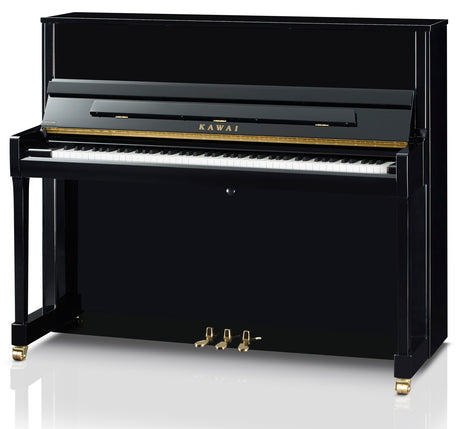
For a new instrument, Yamaha B10 Klavier schwarz poliert and Kawai K-300 Klavier schwarz poliert are two widely chosen entry and mid-range pianos, while Schimmel Classic C 121 Tradition – schwarz poliert represents the premium segment. The Klaviere - Neu category gives an overview of all new models.
05Room acoustics: damp it or let it ring
The location affects not only care but also the sound. A room with hard surfaces, lots of glass and few furnishings sounds loud and reverberant. Carpets, curtains and upholstered furniture dampen the reflections and make the tone rounder and more pleasant.
Conversely, a heavily damped room can make the sound dull. A balanced amount of soft surfaces is usually the best choice. After placing the piano, try two positions, as one metre of clearance from the wall often audibly changes the room sound.
A good location is the cheapest care a piano can get: prefer an inside wall, keep clearance from heating, windows and underfloor heating, watch the humidity and give the instrument time to acclimatise after delivery. Regular tuning keeps the tone enjoyable for years.
Frequently asked questions
Can a piano stand against an outside wall?
What humidity is ideal for a piano?
How far from heating should a piano stand?
When should a newly delivered piano be tuned?
Ready for your piano
From entry-level to premium: explore our new pianos and find the model that fits your room.
Browse new pianosDiscover the Yamaha B10Passende Produkte




Schimmel Classic C 121 Tradition – Polished Ebony