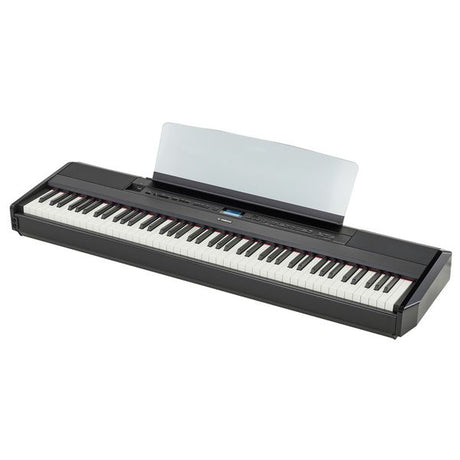
Looking for a portable Yamaha digital piano and comparing the P-145, P-225 and P-525? The current product in the shop is named P-145BT. Across that model, the P-225 and P-525, keyboard designs, sounds and features differ. This guide sets out the manufacturer’s information and connects it with practical questions, rather than claiming a universal ranking.
01What portable P series pianos have in common
All three are portable 88-key digital pianos in Yamaha’s P series. Start by asking whether you want a straightforward instrument for piano playing, additional sounds and controls, or a broader feature set. With any portable piano, consider the instrument and stand separately: check the space you have and how often you expect to move it.
02P-145BT and P-225: a more compact choice
Yamaha describes the P-145BT as an entry model. Its official specifications list a GHC keyboard, CFIIIS piano voice, 64-note polyphony and ten voices. Yamaha also lists Bluetooth Audio and notes that some features may vary by region, so check availability for your market.
Yamaha lists GHC on the P-225 as well, with a Yamaha CFX grand piano voice, VRM Lite, up to 192-note polyphony and 24 voices. Those features may matter if you use different sounds or want the listed sound settings. Polyphony is a technical capacity, not a rating of the sound you will prefer. Consider which voices you use and what connections your setup needs.
03P-525: more keyboard and sound options
Yamaha positions the P-525 as the flagship model in the P series. Its European product information lists GrandTouch-S action with wooden white keys, plus CFX and Bösendorfer Imperial grand piano voices. Official US specifications list 256-note polyphony and 44 voices. This is a broader feature set than the P-145BT or P-225, though not every player will benefit from every addition.
Ask whether you will use the additional voices, keyboard construction and functions in your own playing. If you mainly play piano and want a compact instrument, a simpler setup may be enough. If you switch between grand piano voices and use several sounds, the P-525 details may matter more. Comparing a piece you know will tell you more than the model number alone.
04Compare keyboard, sound and features separately
The P-145BT and P-225 use GHC; Yamaha lists GrandTouch-S with wooden white keys for the P-525. Those names describe different designs, but they cannot tell every player which keyboard they will prefer. If possible, play the same short passage on each instrument: quiet notes, repeated notes and chords. Pay attention to the control that suits your hands, without treating one short impression as a universal test result.
For sound, Yamaha lists CFIIIS for the P-145BT, CFX and VRM Lite for the P-225, and CFX plus Bösendorfer Imperial for the P-525. This distinguishes the manufacturer’s configurations. For a personal comparison, listen to the same music through the same playback method. Speakers, headphones, room acoustics and volume all affect the experience. Voice count and polyphony are feature details, not sound-quality scores.
05Choose according to how you play
Before choosing, write down three things: where the instrument will stay, whether you mainly play piano or switch sounds, and whether you will move it often. The answers help set priorities. For the P-145BT, Yamaha says Bluetooth availability can vary by region. For the P-225, CFX and VRM Lite are concrete features to consider; the P-525 adds GrandTouch-S and the listed grand piano voices.
This is a model guide, not a test report or a claim about a future successor. The official Yamaha pages reviewed describe the listed models and their features but do not establish future model plans. The separate P-S500/P-525 comparison keeps its own focus. To choose among these three P models, start with the features you need and then review the relevant product pages.
Choose the features you will use: a compact feature set, extra sound options, or the P-525’s broader keyboard and sound setup. Yamaha’s information distinguishes the models; your own playing and listening will show which features matter.
Frequently asked questions
Is the Yamaha P-145 called P-145BT?
Which keyboard do the P-145BT and P-225 use?
What does the P-525 add?
Does a search for a successor prove a model change?
Explore Yamaha P series pianos
Compare their features and choose for the way you play.
View the Yamaha P-145BTView the Yamaha P-225View the Yamaha P-525Browse Stage PianosPassende Produkte