
A digital piano with a weighted keyboard is a reliable practice instrument for years. At some point, though, some players notice a diffuse feeling creeping in: fast repeated notes feel sluggish, quiet notes are hard to control precisely, and the pedal feels more like a switch than a gradual control. That is not imagination, it is a real technical difference between a simulated and a genuine piano action.
This article covers that specific upgrade moment: which signs point to an action limitation, what changes with a genuine hammer action, and for whom switching to a hybrid piano makes no difference yet.
01How to tell your keyboard has hit its limit
A weighted digital piano keyboard usually simulates hammer weight through a spring or counterweight built into the key itself, without an actual hammer accelerating and falling back. In the first years of learning, this difference is barely noticeable. More advanced players notice it first in fast repeated notes: on a real action, a note can be re-struck as soon as the hammer has dropped back slightly past the escapement point, while on a simulated keyboard you often have to wait until the key fully returns.
A second sign shows up in the touch curve at very quiet volumes. Anyone seeking fine gradations in pianissimo and instead getting a rather blocky "quiet or louder" is running into the limit of sensor resolution. Neither is a playing mistake, it is the physical difference between a genuine hammer action with wooden hammers and an electronic approximation.
02Dynamics and expression: what a genuine action changes
In a real piano or grand action, striking speed transfers to a hammer that actually accelerates through a continuous motion, not to a fixed number of sensor steps. That creates a finer transition between volume levels and lets you work deliberately with striking speed instead of playing against a noticeable stepping.
On hybrid pianos with a genuine action, such as the Yamaha NU1XA AvantGrand Hybrid Piano – inkl. Lieferung & Aufbau with its upright action or the Kawai Novus NV6 Hybrid Piano schwarz poliert – inkl. Lieferung & Aufbau, this hammer movement is read by non-contact sensors and translated into the digital sound. The sound stays digital, but the feel under your fingers is the same as on an acoustic instrument. That is the core difference from a digital piano: it is not the sound generation that changes first, but the action underneath it.
03Pedal nuance: why the sustain pedal is often the first tell
On a digital piano, the sustain pedal is often read as binary or in a handful of steps, either pressed or not, with limited room for half-pedalling technique. Anyone practising half-pedalling to blend sounds in a controlled way, rather than sustaining fully, notices first that the transition is not smooth.
A genuine action reproduces damper movement continuously: the pedal gradually lifts the dampers from the strings (simulated on a hybrid), creating fine gradations between fully damped and fully open. For advanced players working on pedal nuance, this is often the point where the difference first becomes concretely audible.
04What actually changes when you upgrade
Moving to a hybrid piano brings mainly a new action, not necessarily more floor space or more day-to-day effort. Models such as the Yamaha NU1XA AvantGrand Hybrid Piano – inkl. Lieferung & Aufbau or the Casio Digitalpiano / Hybrid Piano GP-310 Celviano - schwarz matt sit in the same console format as a digital piano, volume stays fully adjustable, headphone practice remains possible, and tuning is still not required.
What changes is the feedback under your fingers: repetition, striking dynamics and pedal feel behave like an acoustic instrument. If you already miss these three points concretely in your own playing, this is a genuine answer rather than another digital approximation.


05Who the upgrade is not worth it for
Not every playing situation benefits from the switch. Anyone still in their first year or two of learning generally does not yet feel the action limitations described here, and a solid digital piano with a good weighted keyboard remains the right fit. Likewise, anyone working mainly with sound variety, auto-accompaniment or recording features rather than classical repertoire gains little from a hybrid piano's action advantages.
It is also worth noting: if you are unsure whether your own touch would actually make use of the finer resolution, you can test the question calmly on a current digital piano model before taking the next step. Our Digitalpianos category gives an overview of the current selection.
Upgrading from a digital piano to a hybrid piano pays off exactly where a simulated keyboard hits real physical limits: repetition, striking dynamics and pedal feel. If you have not yet reached those limits in your own playing, a good digital piano still serves you well.
Frequently asked questions
Do you notice the difference in action right from the first key press?
Does a hybrid piano need more space than my digital piano?
Do I have to give up anything I use on my digital piano?
At what skill level does the switch actually pay off?
Hit the action limit? Hybrid pianos at a glance
From console format to genuine grand action, the stringless hybrids with real striking dynamics.
Browse all digital pianosDiscover the Kawai Novus NV6Passende Produkte
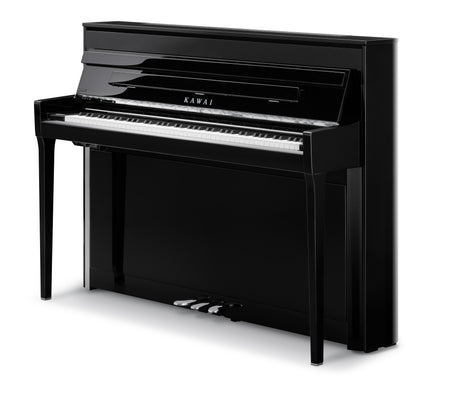
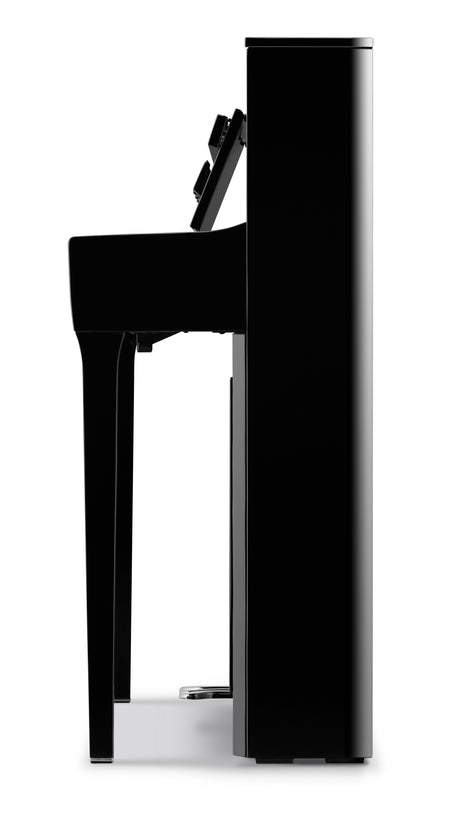
Kawai Novus NV6 Hybrid Piano Polished Ebony – Incl. Delivery & Assembly