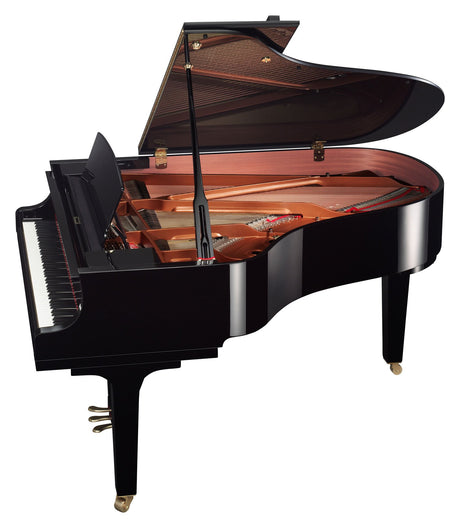
Anyone who wants to play an acoustic piano late at night or through headphones quickly runs into two names: Yamaha TransAcoustic and Kawai AURES. Both solve the same problem in the same surprising way: instead of sending the digital sound through built-in speakers, they turn the soundboard itself into a speaker. That is exactly what a transducer does.
This guide explains the transducer principle across both brands, why it sounds more natural than conventional speakers and who such a piano is right for.
01What a transducer is and how it drives the soundboard
A transducer is a compact vibration converter. It is coupled directly to the wooden soundboard from the inside and turns an electrical audio signal into mechanical vibrations, much like the voice coil in a loudspeaker. Only here it is not a cone that moves, but the large, gently curved spruce soundboard.
That board starts to vibrate and radiates the sound into the room, exactly the path a normally played piano takes through its strings anyway. So the digitally generated tone passes through the same acoustic body as the real piano sound. That is the heart of the principle: the speaker is not a separate component, it is the instrument itself.
02Why it sounds more natural than built-in speakers
Conventional speakers radiate sound from a single small cone. A soundboard, by contrast, is a large, broad sound source made of grown wood, with its own resonances and overtones. The sound spreads more spatially and gently through the room instead of coming from a cabinet.
Because the wood lets the same frequencies resonate that it emphasises during acoustic playing, the result is a warm, full tone that does not feel like a recording from a speaker. There is also the physical sensation: the board and the body vibrate noticeably, so you do not just hear the sound, you feel it as you play, just like on a purely acoustic instrument.


03TransAcoustic and AURES: same principle, two brands
Yamaha calls its technology TransAcoustic (currently TA3, and TC3 on the B30 model). Kawai markets the same basic principle as AURES, now in its second generation AURES 2. Both deliberately do without external speakers and instead drive the soundboard through transducers. Kawai places several converters on the board, while Yamaha engineered a transducer developed specifically for piano soundboards, light enough not to impair the board s tonal function.
An important distinction: TransAcoustic and AURES are genuine acoustic pianos with strings. They can be played fully acoustically at any time. Only when the digital mode is switched on does the transducer come into play and the volume becomes adjustable. That sets them apart both from pure hybrid pianos without strings and from the silent function, which sends the tone to headphones rather than through the soundboard. Our articles on silent and TransAcoustic pianos and on hybrid pianos go deeper into this distinction.
| Technology | Strings? | Sound comes from | Brand examples |
|---|---|---|---|
| TransAcoustic / AURES | yes | Soundboard (transducer) | Yamaha TA3/TC3, Kawai AURES 2 |
| Silent | yes | Headphones | Yamaha SH3/SC3, Kawai ATX |
| Hybrid without strings | no | Digital sound generation | Yamaha AvantGrand, Kawai Novus |
04Who a soundboard-speaker piano is worth it for
The principle is aimed at anyone who wants a full acoustic piano but has to consider neighbours, family or the time of day. During the day you play fully acoustically, in the evening you turn the volume down, without the sound becoming thin or electronic, because it still arises through the wooden body.
Tonally too it is a compromise that is not really one: you do not lose the natural character of the instrument, but you gain volume control, a headphone option and additional voices from the digital section. Our current selection ranges from an entry-level upright to a grand piano, each fitted with TransAcoustic or AURES 2.


The transducer principle answers an old question of buying a piano elegantly: how to play an acoustic instrument without always accepting full volume. TransAcoustic and AURES solve it not with better speakers, but by doing without them and turning the soundboard into a speaker.
Frequently asked questions
Does a transducer piano sound like a real acoustic piano?
What is the difference between TransAcoustic, AURES and silent?
Does a TransAcoustic or AURES piano have built-in speakers?
Are the strings retained and can I play fully acoustically?
Discover pianos with TransAcoustic and AURES
From an entry-level upright to a grand piano, with adjustable volume through the soundboard.
See all new pianosKawai K-300 with AURES 2Passende Produkte
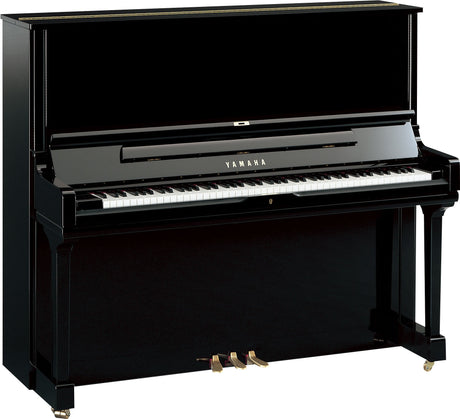

Yamaha YUS-3 Upright Piano in Polished Ebony with TA3 Transacoustic System