

Anyone shopping for piano sheet music quickly faces hundreds of editions of the same piece. Für Elise comes as an Urtext, as an easy arrangement and as part of a collection. That difference decides whether a score motivates you or wears you down.
This guide sorts the offering along two axes: by genre (classical, pop, film, jazz, modern pieces) and by skill level (easy arrangements through to the original edition). That way you find the edition that matches your ability and your taste. For the method behind your practice, see our companion article on choosing a piano method.
01First: settle on level and edition type
Before genre matters, skill level decides. An original edition (Urtext) renders the score exactly as the composer wrote it — no fingering, no simplification. It is the reference for advanced players and for lessons, but often too dense for beginners.
Simplified or arranged editions reduce keys, tempo and voices so a piece becomes playable sooner. Look for the level marking (easy / intermediate / advanced) and whether fingering is printed in. For the first years at the piano, collections with printed fingering and a level marking are the safest choice.
| Edition type | Fingering | Ideal for |
|---|---|---|
| Urtext / original edition | usually without | advanced players, lessons, faithful playing |
| Arrangement / simplified | usually with | beginners, returners, quick wins |
| Collection with level marking | generally with | self-study, broad repertoire |
02Classical: from easy to the original edition
Classical is the largest segment — and the one with the widest range of levels. To get started, collections of well-known pieces in easy versions work well, such as Für Elise - Heumann, Hans-Günter or a cross-section like Easy Classics for Piano 36 originals from Bach to Satie, which gathers originals from Bach to Satie in a playable form.
For faithful playing, reach for the original edition. The Nocturnes für Klavier - Chopin, Frédéric are a typical example: the full score with no simplification, for advanced players. The rule of thumb: assess your level honestly first, then choose between an easy collection and the original edition.


03Pop and modern pieces: chart hits and calm solos
Pop piano sheet music almost always comes as an arrangement — a song set for solo piano, often with chord symbols for your own accompaniment. For beginners, collections with simplified versions like Pop for You vol.1 für Klavier - Labsch, Sandra are a good start, because they keep current pieces playable.
Alongside, the calm, modern piano solo has grown into a segment of its own. Composers such as Yiruma stand for accessible pieces of intermediate difficulty — The Best of Yiruma for piano gathers the best known. Here too the level marking is worth a look, as the range runs from easy to genuinely demanding.


04Film music and soundtrack: from the Disney book to Einaudi
Film music is, for many, the very reason to start the piano. The spectrum runs from easy books for children and beginners like Children's Disney Piano: Die schönsten Disney Hits für Klavier (leicht, dt. Text) to the atmospheric solo pieces by Ludovico Einaudi in Film Music: for piano - Einaudi, Ludovico.
Here too, watch the depth of arrangement: a soundtrack book marked "for easy piano" sounds different from the composer's original version. If you are after a specific film theme, check before buying whether it exists as a single edition or only within a collection.


05Jazz: standards and style
Jazz piano sheet music asks for a vocabulary of its own — chord symbols, voicings, swing phrasing. To get started, standards collections with chords and lyrics like First 50 Jazz Standards You should play on the Piano: for easy piano (with lyrics and chords) are ideal, because they gather the common repertoire in a playable form while inviting you to accompany freely.
Important: jazz editions differ widely in how much is written out. Some give only melody and chords (a lead sheet), others fully notated solos. For self-study without a teacher, fully notated editions are the simpler choice.

You will find your piano sheet music fastest if you settle two questions up front: which genre appeals to you — and what level are you playing at right now? With that bearing, a sprawling offering becomes a short, genuinely fitting shortlist.
Frequently asked questions
What does Urtext mean for piano sheet music?
Do I need piano sheet music with printed fingering?
How do I tell whether an edition matches my level?
Are pop and film scores always arrangements?
Find the right piano sheet music
Browse the range by genre and skill level — from the easy collection to the original edition.
View all sheet musicClassical classic: Für ElisePassende Produkte
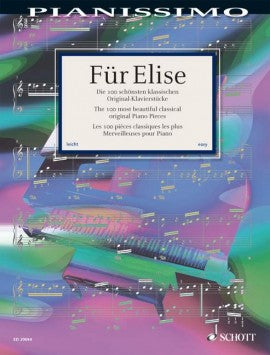
For Elise - Heumann, Hans-Günter

Easy Classics for Piano 36 Originals from Bach to Satie

Nocturnes for Piano - Chopin, Frédéric

Pop for You vol.1 for piano - Labsch, Sandra


Film Music: for Piano - Einaudi, Ludovico

First 50 Jazz Standards You should play on the Piano: for easy piano (with lyrics and chords)