
A chin rest for violin or viola looks unremarkable, yet it is the one point where instrument and player stay in constant contact. Its shape and material decide whether the instrument can be held securely and without tension.
Many players only know the standard chin rest that came with their instrument and underestimate how many shapes and materials exist. Switching is usually straightforward and worthwhile whenever posture or comfort does not feel right.
01Why the chin rest shapes comfort
A chin rest carries the contact between chin, or jaw, and the instrument. It lets a violin or viola be held without pressing the shoulder up hard, keeping the left hand free for shifts and vibrato.
If the chin rest does not fit well, players typically compensate with more pressure, which leads to tension in the neck and shoulder. A well-fitting chin rest is therefore not a comfort extra but part of a healthy playing posture.
02Shape: center-mount or side-mount
Chin rests differ first in their position relative to the tailpiece. A center-mount rest sits centered over the tailpiece, symmetrical to the instrument's midline, offering a compact, even contact area. The Gewa Kinnhalter MORAWETZ für Violine 4/4 follows this principle.
A side-mount rest sits to the left of the tailpiece and follows the natural position of the jaw more closely. Models such as the Gewa Kinnhalter Wiener für Violine 4/4 are built this way and offer an asymmetrical contact surface that suits many players with a stronger jaw position. Which shape fits is individual, jaw shape, neck length and shoulder rest all play together.


03Material: ebony, composite and everything between
Classic chin rests are made from ebony, a hard, dense wood with a pleasant feel that visually matches a dark instrument finish. The GEWA KINNHALTER FLESCH aus Ebenholz für Violine 4/4 is an example of this build, with a high rim for a more elevated neck position.
There are also chin rests made from composite material, considerably lighter and often available with finer gradations of shape and rim height. The GEWA KINNHALTER TEKA für Violine 4/4 follows this approach. Anyone sensitive to nickel in the clamp mechanism should also check the material of the clamp itself, not only the chin rest, hypoallergenic alternatives are available through accessory suppliers.


04Fit: height, rim and jaw shape
Rim height, how far the chin rest rises above the rib of the instrument, determines the distance between chin and instrument. A chin rest that sits too low forces the head downward, one that sits too high tilts the instrument. Both make bowing and vibrato harder.
The simplest way to find the right height is a direct comparison: hold the instrument in playing position without raising the shoulder, then check whether the chin rests comfortably. High-rim models such as Flesch-style rests suit players with a longer neck or a taller shoulder rest, while flatter shapes suit a shorter distance.
| Model | Mounting | Material | Notable feature |
|---|---|---|---|
| Morawetz | Center, over the tailpiece | Ebony | Compact and symmetrical |
| Wiener (Vienna) | Side-mount | Ebony | Asymmetrical jaw contact |
| Flesch (ebony) | Side-mount, high rim | Ebony | For a greater chin-to-instrument distance |
| Teka | Side-mount | Composite | Low weight |
05Viola: what matters in addition
For the viola, the same logic applies as for the violin, just with a larger body and more weight. The contact area can afford to be somewhat more generous, so the chin does not need to balance on too small a surface.
Many side-mounted models designed for violin are also available in a larger version for viola. It is worth asking specifically for the viola fit when buying, since a violin model does not automatically transfer one to one. Our Streicher - Zubehör category gives an overview of the full range of accessories for string instruments.
Shape and material together determine how securely and comfortably a violin or viola can be held. If you are unsure between center-mount and side-mount, or between ebony and composite, start from your own jaw shape and shoulder rest rather than from looks.
Frequently asked questions
What is the difference between center-mount and side-mount
Which material works well for sensitive skin
Does a violin chin rest also fit a viola
How can I tell the rim height does not fit
Find the right chin rest
From center-mount to side-mount, from ebony to composite, an overview of string instrument accessories.
Browse string instrument accessoriesDiscover the GEWA Flesch chin restPassende Produkte
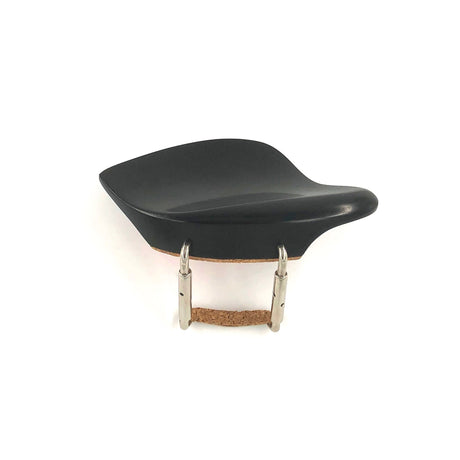
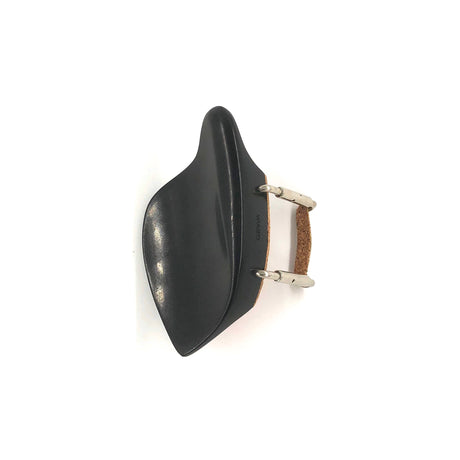
Gewa chinrest MORAWETZ for violin 4/4


Gewa Wiener chinrest for violin 4/4
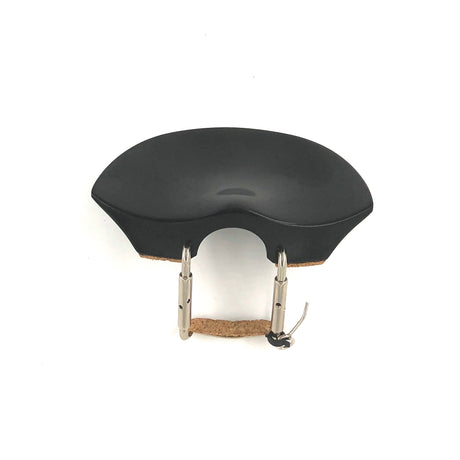
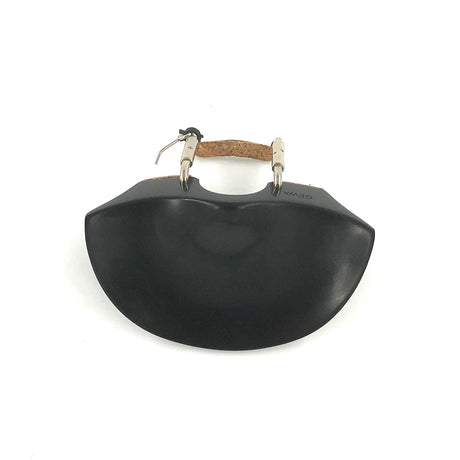
GEWA CHINREST FLESCH made of ebony for violin 4/4