A hybrid piano feels under the fingers like an acoustic upright or grand, yet it has no strings. Many players ask, after the first few notes, why a hybrid piano is built without strings when the expensive wooden action is clearly there.
The short answer: the strings are exactly the part that makes an acoustic piano delicate, maintenance-heavy and loud. Leave them out and generate the sound digitally, and you keep the touch while losing the drawbacks. This guide explains the design and separates it cleanly from the silent piano, which does have strings.
01What a hybrid piano is and is not
A hybrid piano combines a mechanical keyboard with digital sound generation. At its heart sits a real upright or grand action with a full hammer mechanism, the same kind found in acoustic instruments. Press a key and the hammer moves as usual, but it strikes no string. Instead, optical sensors read the touch and a tone generator plays back a sampled or modelled piano sound. On the Yamaha NU1XA the action uses genuine wooden hammers, while the Kawai Novus relies on its graded Millennium III action.
That makes the distinction clear: a stringless hybrid piano like the Yamaha NU1XA AvantGrand Hybrid Piano – inkl. Lieferung & Aufbau or the Kawai Novus NV6 Hybrid Piano schwarz poliert – inkl. Lieferung & Aufbau has a real action but no strings. A silent piano, by contrast, is a full acoustic piano with strings, where a stop rail halts the hammers just before the string only in silent mode. Both sound digital through headphones, yet only the silent piano can return to full acoustic play at any time.
02Why the strings are left out on purpose
The strings in a piano are under enormous tension. That very tension gives the beautiful tone, but also the fragility. Wood and steel react to temperature and humidity, which is why an acoustic piano has to be tuned regularly and responds to climate changes. Remove the strings and you remove exactly these weak points.
A hybrid piano never needs tuning, because the sound is generated digitally and cannot go out of tune. It stays tonally stable whether it sits against an outside wall, next to a radiator or in a dry attic. The expensive wooden action is kept, only the tonally vulnerable part is replaced by wear-free electronics.


03The practical everyday advantages
The most visible advantage is volume. Since no acoustic sound comes from strings, the volume can be freely adjusted or muted entirely through headphones. Practising at six in the morning or late at night becomes possible without housemates or neighbours hearing a thing.
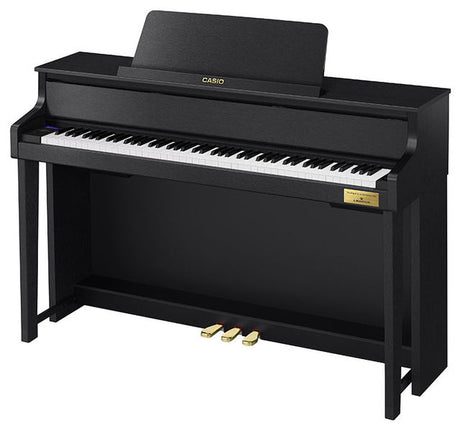
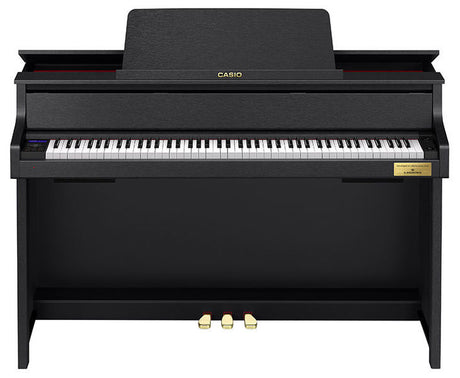
Then there is the low maintenance. No tunings, no string regulation, no worry about air that is too dry or too humid. Sound generation relies, depending on the maker, on sampled sounds or on sound models. Yamaha and Kawai lean towards sampling specific concert grands, while Casio uses a modelling-based approach in the Casio Digitalpiano / Hybrid Piano GP-310 Celviano - schwarz matt. Both approaches sound convincing, but take a different route to the tone.

04Stringless hybrid or silent with strings: which fits
The choice comes down to whether you want to keep the acoustic sound in the room. If you value the natural tone of a real piano and only want to practise quietly now and then, an acoustic piano with a silent system serves you better, as it stays fully acoustic at any time. If you mainly want the real action but would rather leave maintenance, tuning and volume worries behind, a stringless hybrid piano is the more consistent choice.
Our overview Digitalpianos brings both worlds together. For a deeper comparison of the designs, see our foundational article on hybrid piano technology as well as the spotlight on the Kawai Novus NV6.
| Feature | Hybrid without strings | Acoustic with silent |
|---|---|---|
| Strings | no | yes |
| Real piano action | yes | yes |
| Tuning required | no | yes, regularly |
| Adjustable volume | yes, fully | only in silent mode |
| Acoustic sound in the room | no | yes |
| Climate sensitive | barely | yes |
A hybrid piano without strings is not a compromise but a deliberate design: real action for the touch, digital sound generation for tuning stability, adjustable volume and low maintenance. If you do not need the acoustic room sound, you gain an instrument that stays easy to live with for years.
Frequently asked questions
Does a hybrid piano really have no strings at all?
Does a hybrid piano need tuning?
How does a hybrid piano differ from a silent piano?
Can I practise quietly on a hybrid piano?
Discover hybrid pianos at Musik Ebert
From the compact entry point to the grand experience, our stringless hybrid pianos combine real action with digital stability.
Browse all digital pianosDiscover the Yamaha NU1XAPassende Produkte
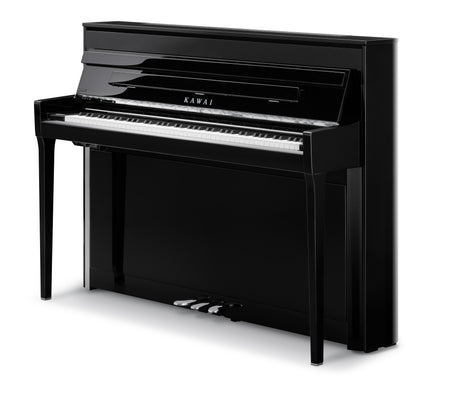
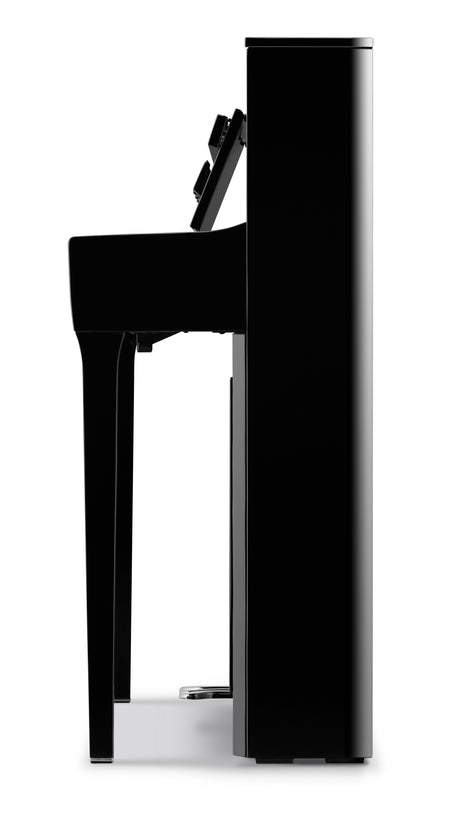
Kawai Novus NV6 Hybrid Piano Polished Ebony – Incl. Delivery & Assembly